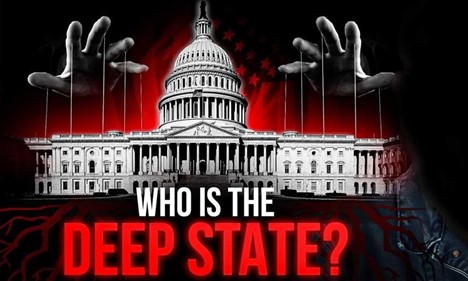
When discussing the true protagonists behind various events and the machinations that drive them, the term “Deep State” is frequently invoked. Beyond mere secret services, high-level public bureaucracies, and a nation’s military apparatus, the term denotes a permanent, overarching power—a web of interconnected private interests, state institutions, and transnational organizations.
It generally refers to the governing apparatus, the leadership, the senior administration, and the intelligence services of the United States. It is, therefore, essential to learn more about this nexus of power—opaque, yet increasingly less hidden—that shapes our lives and directs the actions of visible authorities and governments, all while disregarding the popular will and the established procedures of formal democracy. To gain clarity and distinguish the masks from the true face of this power, the recent publication The Deep State: The Fall of the Constitution and the Rise of a Shadow Government proves highly valuable. The author, Mike Lofgren, is an insider within American elite circles, having long served as a senior official in the U.S. Congress.
Lofgren, a liberal, stands in opposition to the American right, yet he remains untainted by the dogmatic ideologies of the left. With great expertise, he guides us through the arcana imperii —the secrets of state—and the labyrinthine corridors of Washington (often referred to by Americans as “D.C”.—the District of Columbia—or simply “The District”). This is the capital where the governmental “Deep State” is concentrated, though it does not encompass the entirety of the American oligarchic structure. A power structure that is essentially static and impervious to changes in government—Lofgren argues that the U.S. is effectively a one-party state divided into factions, deeply invested in its own preservation, and accessible only through co-optation or hereditary-like designation. The book draws a parallel to the “iron cage” described by Max Weber: a framework through which modern society organizes itself based on criteria of efficiency, calculability, and technical control—a self-referential structure composed of capitalist markets, formal laws, and rigid bureaucratic apparatuses.
This structure encompasses the leadership of the military-industrial complex—which President Eisenhower identified as a threat to democracy as early as 1960—as well as officials from major federal security agencies (the CIA, the National Security Agency, and the powerful Department of Homeland Security, which oversees public safety, national territory protection, immigration, and cybersecurity), along with the top echelons of the State Department and the Department of Defense. Silicon Valley giants—Google, Facebook, Apple, Microsoft, Starlink, and Palantir—are also full-fledged members of the “Deep State”, as is Wall Street, the global financial hierarchy, which occupies a position at the very apex. With undeniable courage, Lofgren adds the U.S. judicial system and certain sectors of organized crime to this list of entrenched powers. The Deep State is, in short, “the great story of our time. It is the common thread connecting the war on terror and the militarization of foreign policy, the financialization and deindustrialization of the American economy, the rise of a plutocratic social structure—which has resulted in the most unequal society seen in the last century—and the political dysfunction that has paralyzed the day-to-day functioning of government”. Much of the formal “Deep State” has its physical headquarters on Massachusetts Avenue in Washington, D.C.—the thoroughfare of major lobbyists—and on Madison Avenue, the realm of arms dealers and the military-industrial complex. This world is far more than a mere establishment; it is an all-encompassing culture—an “imperial” environment governed by its own internal logic, language, and rituals. Peter Lofgren identifies and critiques this world from within the “Beltway”—the highway encircling Washington that encloses the core of that global, secretive, and cross-partisan power structure we call the Deep State. It emerged in the post-war era as the definitive expression of the “American Century”—reflecting both its arrogance and its anxieties—and expanded significantly from the 1970s onward through the growth of various external branches, such as non-governmental organizations (NGOs) and multi-billion-dollar foundations. These entities, which enjoy substantial tax advantages, serve as direct extensions of government agencies, intelligence services, and major industrial and financial dynasties.
The Deep State ensures continuity across various political administrations—even between Bush and Obama, the latter initially reluctant but subsequently a faithful executor of the Deep State’s agenda. Financially, the Deep State manages vast sums from the federal budget—amounts difficult to even quantify, largely opaque and unaccounted for—in addition to incalculable contributions from the private sector. It serves to keep everything and everyone under control, orchestrating covert operations of all kinds globally—including coups and wars—supported by six hundred U.S. military bases, the subservience of foreign governments, and the immense influence of financial institutions. The power of these institutions has expanded significantly since the 1990s, following the collapse of Soviet communism and the sense of omnipotence that permeated the United States as the sole remaining superpower. There is an inextricable link to the Pentagon—the seat of the Department of Defense—along with relentless lobbying of members of the House and Senate, for whom the Deep State frequently drafts parliamentary speeches and public remarks. Its fuel is money, combined with blackmail: they know, they monitor, they record, and they eventually present the bill.
The Deep State lies at the heart of every control and surveillance project undertaken in recent decades, in alliance with Silicon Valley; it exerts broad control over the Internet and holds the keys to the global flow of information. The Deep State is the concrete realization of Jeremy Bentham’s “Panopticon”—a radial control system that, as the name implies, sees everything. It anticipates, organizes, and determines. Secrecy is a cornerstone of this “super-state”, which strives to remain invisible. This is no simple matter within a system whose objective is to monitor and govern the entire world—a system encompassing between 600,000 and 800,000 individuals who hold a TS/SCI clearance (Top-Secret/Sensitive Compartmented Information), an authorization granting access to highly classified, compartmentalized data. The reliability of the information in the book is underscored by the fact that Lofgren himself holds a high-level TS/SCI clearance.
It comes as no surprise that the “Deep State” also controls the SWIFT (Society for Worldwide Interbank Financial Telecommunication) system—the global network for encrypted messaging that enables (or blocks!) financial transfers. Lofgren confirms that the operation leading to the killing of Gaddafi in 2011, while ostensibly carried out by the French and British, was actually orchestrated by the U.S. Deep State, which was anxious to nip in the bud a proposed African currency intended for settling payments for oil products—an initiative that had previously contributed to the downfall of Saddam Hussein. One might recall the vial brandished by Colin Powell at the UN, which he claimed contained lethal chemical agents held by Iraq. Also highly significant is the co-optation of tech leaders into the Deep State—figures such as Peter Thiel (a self-styled humanist and admirer of the ultra-libertarian Ayn Rand), as well as Elon Musk and Bill Gates.
A distinctly American trait is the veneration of wealth; the Deep State serves as the ultimate guardian of plutocracy. The book provides numerous examples of the Supreme Court’s complicity with major corporations, multinationals, investment funds, and the military-industrial complex. A similar, pervasive subordination extends to Congress and the Senate, which often act as mere mouthpieces for the interests of the Deep State and the “corporate” system that funds their election campaigns. Where a permanent power—anchored in military, financial, and economic interests—prevails, and where the most powerful private entities fund politics, thereby creating “corporate capitalism”, the popular will (theoretically represented in Congress) counts for very little. As Lofgren puts it: “While politicians engage in high-flown rhetoric about work, faith, family, and so on, when the discussion shifts from ethereal slogans to specific policies, they do not seek to align themselves with the needs of the majority—except for those desires that happen to coincide with the preferences of the very people footing the bill. Thus, time and again, the position favored by the elites ultimately prevails”.
Politicians do not cease to be agents of the “Deep State” once their terms end; figures like Hillary Clinton, for instance, command $200,000 for every public appearance or lecture. How could they possibly turn against those who sign their paychecks? The obsessions of the Deep State—control over society and individuals, alongside a fixation on secrecy—amount to a collective psychopathy within a system that is frequently dysfunctional, riddled with internal infighting, careerism, and blackmail. While the book’s diagnosis is as precise as it is unsparing, the solution proposed by the author is far less convincing. A system like the Deep State—defended without the slightest compunction, even at the cost of murders and wars—cannot be dismantled through mild remedies or appeals for “better” policies. Lofgren calls for the removal of private money from elections—a mere illusion, given that the Deep State is, by definition, a matter of lobbying and influence at the highest political levels. Even less realistic is his proposal to scale back the intelligence apparatus.
The Deep State: The Fall of the Constitution and the Rise of a Shadow Government is well worth reading, if only for the sheer volume of information, historical analysis, and anecdotes regarding the American oligarchies. It sheds light on the invisibility with which true power likes to cloak itself, unmasking its key players, its ideology, its web of relationships, and the intricate, network-like structure that extends from Washington, D.C., to the far-flung provinces of the American empire. Its ultimate goal is to dominate, control, and surveil everything and everyone—all to ensure its own survival and, by extension, the endurance of the American empire itself: a manifestation of what Vilfredo Pareto described as the persistence of social aggregates.
* Roberto Pecchioli is a scholar of geopolitics, economics, and history, he has been actively involved in journalism for years, collaborating with magazines, cultural websites, and blogs. He has written several books, including Manualetto di Antieconomia; Tecnopolis; Elogio dell’eredità; Volontà d’impotenza; and Dizionario del politico corretto e della newspeak.