The war that began on February 28 did more than strike Iran. It redrew the corridor map of Eurasia. With shipping through the Strait of Hormuz disrupted and Iran's ports under blockade, the southern routes through Iran were exposed, and Asia–Europe trade shifted toward the Middle Corridor, which bypasses both Russia and Iran.
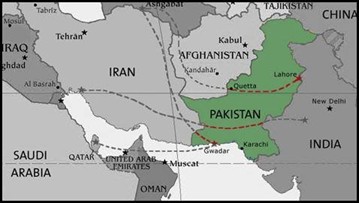
MduThe cumulative effect is to leave one north–south outlet to warm water outside Iran: the route through Afghanistan and Pakistan. Pakistan has, almost by default, become Eurasia's contested southern gateway. Russia needs its route, China needs its stability, the United States wants its minerals, and the Gulf wants its soldiers. That is a measure of Pakistan's value. It is not yet a measure of its power. The question is whether Islamabad can convert strategic geography into strategic agency, or whether its future will be set by the competition of others.
Start with Washington. Talk of an American exit from the Middle East misreads the moment. The war exposed the vulnerability of fixed Gulf bases, and the Pentagon is reportedly weighing a smaller, more dispersed footprint. That is a change of instruments, not interests. In Central Asia, the instruments are commercial: the C5+1 critical-minerals dialogue met in person for the first time in Astana in June, and a single Special Envoy for South and Central Asia, Sergio Gor, now covers both regions. One envoy for two regions says much about how Washington reads the map. The minerals are real. Central Asia holds at least 32 of the 60 minerals the U.S. classifies as critical, and Pakistan's Reko Diq project has drawn American export financing. But minerals become power only when processed and moved, and China dominates processing. The contest over minerals is, in the end, a contest over routes.
And routes are precisely where Russia and China are most exposed. Moscow's North–South Corridor still lacks its Rasht–Astara link inside Iran, with construction not expected before 2027.
Hence Russia's new interest in a Trans-Afghan line, and this month's first-ever visit to Islamabad by a Russian interior minister. Beijing, for its part, hosted Pakistan–Afghanistan mediation in Urumqi, in Xinjiang itself: diplomacy as self-defense. No single wall encircles Moscow and Beijing, but their most secure path to the Indian Ocean now runs through Pakistan. That raises Pakistan's value. It also raises its exposure.
The threat follows the value. The UN Monitoring Team reports more than 20 terrorist groups active in Afghanistan, among them al-Qaeda, Islamic State Khorasan Province (ISKP), and the Tehreek-e-Taliban Pakistan (TTP), whose roughly 6,000 fighters enjoy freedom of movement. When the Moscow Format sought this month to name terrorism in Afghanistan, the Taliban delegation refused.
This is not Pakistan's problem alone. The East Turkistan Islamic Movement threatens Xinjiang; the Islamic Movement of Uzbekistan and Jamaat Ansarullah threaten Central Asia; ISKP has struck Russia itself. Every state invested in these corridors shares the risk.
On Pakistan's eastern front, the India–Israel partnership is moving from purchase toward co-production of drones, precision weapons, and sensors. In the May 2025 conflict, Pakistan's military reported Indian use of Israeli-made Harop loitering munitions. Islamabad has long maintained that New Delhi is backing the TTP and Baloch militants from Afghan soil; the result for Pakistani planners is a genuine multi-front dilemma.
Since last year, Islamabad's response has been to widen its alignments. The Makkah Defense Alliance, signed on August 7, builds on the 2025 Saudi–Pakistan pact and commits Saudi Arabia, Türkiye, and Pakistan to treat an attack on one as an attack on all. It was invoked for the first time on October 5, with deployments to Saudi Arabia against Houthi attacks. The pact reaches well beyond the Gulf. Pakistan's position, defending Saudi territory while joining no offensive action, is what lets it stand with Riyadh and still keep a channel to Tehran. Chinese-origin air defense systems operated by Pakistani personnel already form part of Saudi defenses. And for India, a bilateral rivalry now meets a network of Pakistani alignments with Riyadh, Ankara, and Beijing.
Yet the alliance raises a question of bandwidth: can a state facing insurgency on its western frontier sustain commitments in the Gulf? The same paradox shadows Pakistan's chairmanship of the Shanghai Cooperation Organization, run under a connectivity theme. The principal Trans-Afghan route would enter through Kurram into Khyber Pakhtunkhwa, Pakistan's least secure territory. The chairmanship will be judged on whether it puts security before corridors.
What should Pakistan do? First, treat connectivity as a portfolio, not a single bet. It has four potential gateways: the Uzbekistan–Afghanistan–Pakistan railway, Kazakhstan's proposed route via Herat and Kandahar, CPEC, and links through Iran. But the vulnerabilities are more concentrated than the options. Both northern routes cross Afghanistan, where the main border crossings have been closed to trade since October 2025, a full year with no reopening date; CPEC depends on security in Balochistan, where militants have targeted Chinese nationals; the western route runs through a country at war. A gateway that depends on one route is a hostage, not an asset.
Second, make corridors conditional. Rail commitments through Afghanistan should be tied to verifiable security milestones, and the SCO's Regional Anti-Terrorist Structure should host a standing Afghanistan counterterrorism track anchored in the UN Monitoring Team's findings.
Third, keep the Makkah alliance defensive, in writing as well as in practice. Diversifying security partners, not substituting for the United States, is the right reading and the right policy.
Fourth, finish what has been signed. Projects such as the long-delayed Pakistan Stream gas pipeline should be held to completion dates rather than renewed in fresh memoranda, and corridor commitments anchored in legislation and provincial consensus so they outlast governments.
The map of Eurasia now runs through Pakistan. Whether Pakistan holds the key or merely stands in the doorway will depend less on the ambitions of great powers than on its own capacity to govern, secure, and deliver.
*Dr. Gul.i.Ayesha Bhatti is a current affairs analyst and faculty at the National University of Science and Technology (NUST), Islamabad, Pakistan.